
About Me
Hey! I'm Eli Tisor, and I'm an aspiring game designer with a background in software development and interactive design. I've always been fascinated with games and what makes them fun. Gameplay mechanics, feedback loops, and player progression are all examples of things I consider while playing games, and I am always amazed by how such seemingly small creative design decisions can significantly impact the player's experience.
With an Associate's degree in Augmented and Virtual Reality as well as a Bachelor's degree in Computer Science with a minor in Interactive Media and Design, I bring technical and creative perspectives to my work. I have worked collaboratively and independently designing and developing interactive systems that include: turn-based gameplay, UI/UX prototypes, and AR experiences. My background and experiences have also given me the opportunity to hone my design skills in other fields as well, such as instructional and web design.
Right now I am currently developing a card game called Duel Decks, starting development on an arena-based roguelike in Unity, and porting an academic project, WinQuest, to Unity for a mobile release, so I can continue to grow my skills and hone my craft even after getting my degrees.
I believe that great games are created when the most passionate of people are striving to make something that is truly impactful to those who play it.
Current Projects
Duel Decks is a fast-paced card game designed for 1v1, 2v2, or free-for-all matches up to four players. The base game includes four 40-card decks representing different characters and playstyles. Each character deck features cards to attack, defend, or use unique skills that reflect the character's strengths and personalities.
For example, the fighter's skills focus on offense, the rogue's skills can steal and play cards from other players, the mage has skills that debuff opponents, and the cleric has the ability to heal. Each deck feels different to play and encourages players to form different strategies depending on what deck they choose.
The game is designed to be easy to learn and quick to jump into. Each turn has players choosing and revealing their cards simultaneously which leads to some fun and intense gameplay. Players have to think strategically to try and determine the best times to play high cards, defend an attack, or use their skills. If two players attack each other with matching numbered attack cards then a "duel" begins where both players reveal the top three cards from their decks to play immediately which creates a sense of unpredictability when it happens.
I built Duel Decks with game nights in mind. I wanted to create something approachable that doesn't take hours to learn while still being strategic and having depth to it's gameplay. I've also designed it so that more characters and decks can be created for future expansions as well. I'm currently working with an artist on a final production build and am aiming for a full release in late 2026 or early 2027.
Project Gladiator
(Working Title)
Project Gladiator is a 2D isometric roguelike arena brawler built around a risk-reward streak system. Players fight through arena encounters and bosses while choosing whether to enter a rest area to heal and shop, or push their streak to increase both their gold multiplier and the game's difficulty.
Gold is earned from the crowd after each fight and scales based on how long the player maintains their streak. The streak ends when the player chooses to return to the rest area in-between rounds. While in the rest area players can spend their gold on randomized weapons and relics to modify stats or introduce unique effects such as lifesteal, poison damage, etc. Shop inventory is limited per visit to encourage players to think carefully about when to spend and when to keep pushing forward.
Combat focuses on melee encounters with dodge-based movement and was inspired by games like The Legend of Zelda, Death's Door, and Tunic. The relic and weapons systems were inspired by games like The Binding of Isaac and Slay the Spire which adds variety and replayability aspects to the game. Each run resets on death, but players unlock new weapons and relics over time to expand their arensel of possible builds and encourages experimentation.
I designed Project Gladiator around the idea of player choice and meaningful risk. The tension between maintaining your streak and knowing when to reset is what shapes each run and gives the player that "just one more run" experience. It's currently in active design and prototyping.
You can view my game design document for this project here.
Previous Projects
Amoeba 🦠
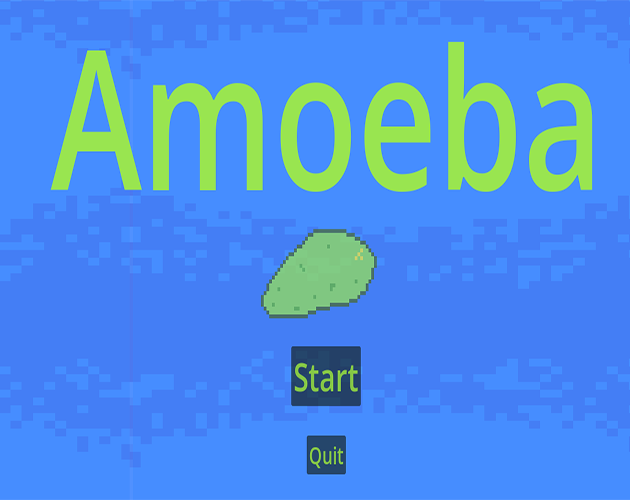
Amoeba is my submission to the Spring 2D Jam '26. The theme was "Evolution" and it was a 48 hour game jam that I entered in solo.
The game is made in Godot and has the player controlling an amoeba that evolves as they defeat other micro organisms. The player starts with a limited field of view and can only dash. After dashing into the other micro organisms and defeating them they will drop a body part. The parts to collect are eyes to increase your field of view, a mouth to do more damage, and spikes for defense. To complete the game you just need to survive while also defeating a certain number of enemies.
The game is heavily inspired by the 2008 game Spore developed by Maxis. I felt the cell stage from that game would be a good way of showcasing evolution while also keeping the game low scope enough to be able to be finished within the short deadline.
All artwork, coding, and design was done by me within the 48 hour jam window. The only thing not created by me was the sounds in the game as those were from a SFX bundle I had purchased years ago. If I had more time with development I would have liked to include more body parts to evolve on to the player, such as a poison cloud when they dashed as well as fins to make them swim faster.
Out of 68 submissions it ranked 34 overall and ranked 30 for gameplay/fun. I'm happy with the placement being that it was my first game jam and I was a solo entry. I received a ton of feedback from the other participates on improvements and mutliple people praised the gameplay and the Spore inspiration.
You can play Ameoba 🦠 here.
Study Buddy
Study Buddy is a gamified study app prototype that I created to showcase how UI/UX design and progression systems can make productivity and studying feel enaging instead of repetitive. I was tasked to create a prototype of a study app so I decided to redesign studying to be fun and interactive apart from just taking notes or being a checklist.
The app focuses on a customizable buddy that grows alongside the user. The user can take notes within the app and turn those notes into flash cards that then can be played to reinforce studying, but to also gain experience points for their buddy and gold for the shop. Another way to earn experience and gold is by setting daily, weekly, or monthly goals for themselves. Once the user gains enough gold from games of matching flash cards and completing goals they can go into a shop to purchase other buddies, cosmetic gear for their buddy, or new habits that their buddy can live in.
The interface is designed to be simple and readable. I wanted aspects like the user's progression, currency totals, and reward values to always be visible so that the users can see exactly how their effort translates to growth. The user's stats are easily accessible and shared with friends of the app to encourage playful competitiveness and rivalry to keep players motivated to push forward alongside their friends.
I designed Study Buddy with fun, motivation, and emotional investment in mind. Attaching productivity and studying to character growth and customization creates a feedback loop that reinforces consistent habits in a fun and engaging way.
WinQuest
WinQuest is a turn-based RPG that I developed in C# using WinForms as the final project for a C# course while earning my computer science degree. The assignment allowed us to create any interesting program, so I decided to challenge myself by building a fully playable RPG.
Developed in about 8 weeks, the game features a progression system where players level up and allocate stat points to match their preferred playstyle. Combat revolves around elemental spells and enemy weaknesses which encourages players to think strategically about how they approach each battle. The game includes four different environments that have their own unique enemies and boss encounters for players to defeat.
One of the most valuable parts of developing this project was learning how to manage scope and design around a strict deadline. Small design decisions often affected larger systems in the game. For example, I originally considered adding healing potions that could drop from enemies or be purchased in a store. However, that would have required a currency and shop system which would have significantly increased the development time. I implemented a healing spell and allowed players to regain magic points when they defend instead. That supported the gameplay loop, made survival for the player easier, and while kept the project's scope manageable.
I would have liked to include a save feature so players could return to their progress after closing the game or losing. Due to the limited development window I focused on completing the core gameplay experience instead. I plan to revisit the project in the future by rebuilding it in Unity and expanding it into a mobile version with additional features and improvements.
You can see my GitHub page for this project here.
Tic-Tac-Toe
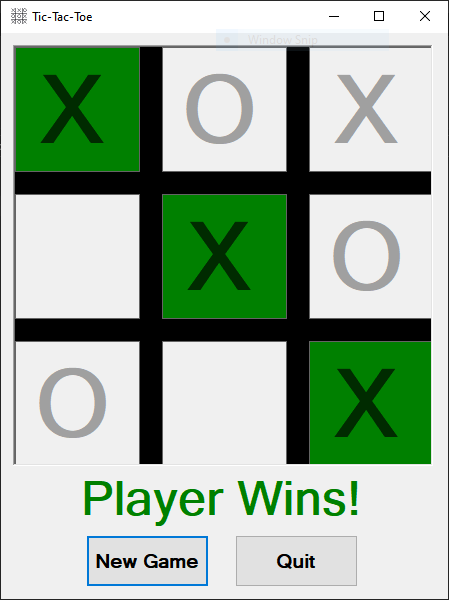


This Tic-Tac-Toe game was developed in C# using WinForms as part of an assignment where we were asked to create a program that involved computer decision-making. I chose to build a version of Tic-Tac-Toe where the player competes against a computer opponent.
The computer player was designed to make strategic decisions instead of choosing moves randomly. It first checks if it has a move that would result in a win. If no winning move is available, it then checks if the player is about to win and blocks that move. If neither situation occurs, the computer prioritizes placing marks in rows it has already started to build toward a win.
Even though Tic-Tac-Toe is a simple game, this project was a great exercise in building logical decision systems and creating the feeling of playing against an intelligent opponent. Designing the computer’s decision-making process helped me better understand how to structure conditional logic and gameplay behavior.
You can see my GitHub page for this project here.
Wastewater AR App
This augmented reality application was developed in Unity by a team of about eight people to teach users about wastewater sampling. I worked on this project while pursuing my Associate's degree. Our team was divided into programmers and 3D modelers, and although I was originally assigned as a programmer, I ended up working closely with the project manager and became the primary designer for the experience.
After researching the topic and meeting with subject matter experts, we learned the process for collecting three different types of wastewater samples. We then designed interactive modules that guided users through each process on their phones. Each module first provides a step-by-step walkthrough of the sampling procedure followed by an interactive test where users must reenact the steps they learned.
Working collaboratively on this project was the experience that first sparked my interest in development and design. I was often referred to as an "information sponge" by the team, which led to me becoming a central source of input on how the models should be placed and how they should function within each module. This project was my first large development experience and helped solidify my passion for creating interactive systems.
Contact
While this portfolio primarily highlights my work in game design and interactive systems, I am always interested in collaborating on other creative and technical projects as well. My background includes experience in software development, UI/UX prototyping, web design, and graphic design, and I enjoy applying these skills across a variety of disciplines. If you have a project, collaboration opportunity, or general inquiry, feel free to reach out using the form below. I'd be happy to connect and discuss how I can help bring your ideas to life!
Github: https://github.com/MrSchnazzy
LinkedIn: https://www.linkedin.com/in/Eli-Tisor/